How Light Became a Material
“Some materials are discovered. Others are imagined into existence.”
Long before it entered architecture, fashion or contemporary design, glass occupied a unique place in human culture. Ancient societies admired it not because it replaced precious stones, but because it possessed a character unlike any other material. Transparent yet solid, delicate yet enduring, it blurred the boundary between nature and human creation.
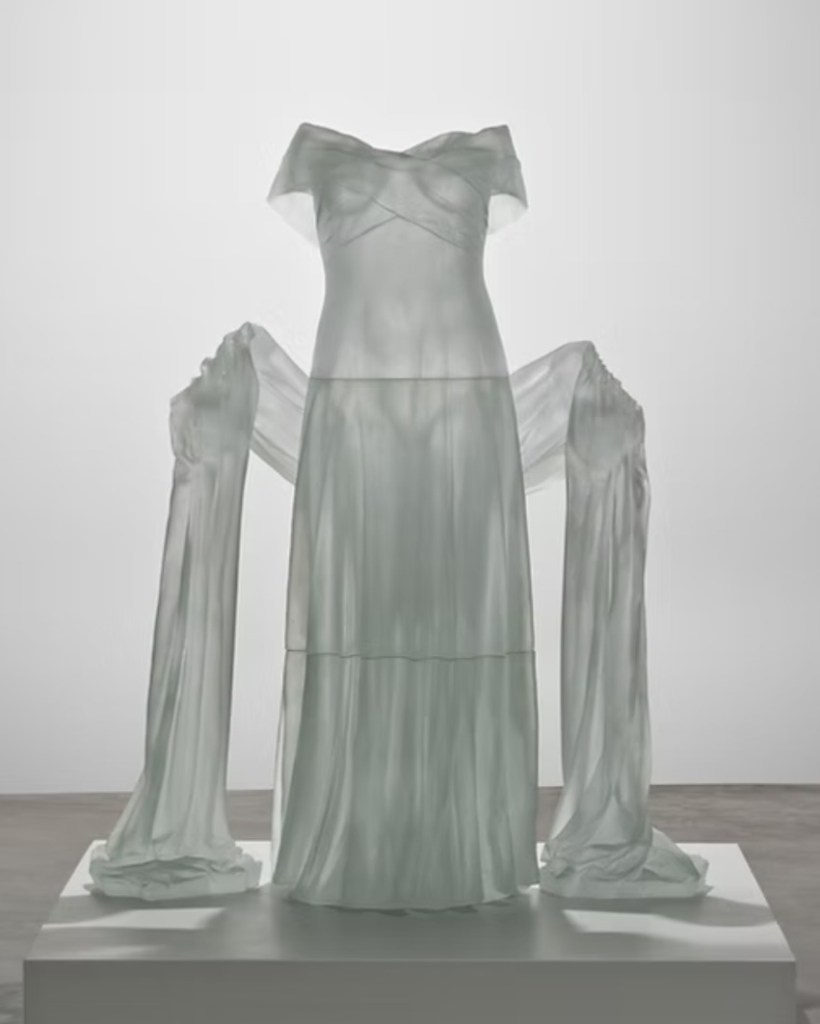
Courtesy of the artist.
As techniques evolved, so did its meaning. Roman craftsmen expanded its use beyond luxury and rarity, while the workshops of Murano transformed glassmaking into a cultural legacy built on precision, experimentation and extraordinary manual skill.
Glass never reveals the same face twice. Morning light softens it, evening shadows deepen it, and artificial illumination gives it an entirely different presence. Every encounter depends as much on the observer as on the object itself, making perception an essential part of the experience.
This quality continues to inspire contemporary artists. Karen LaMonte’s cast-glass sculptures preserve the silent presence of garments whose wearers have disappeared, allowing absence to speak through weight, transparency and form. Rather than depicting the body, her work invites viewers to imagine it.
Glass continues to fascinate because it refuses to remain fixed. It absorbs light, reshapes space and changes with every point of view. Few materials remind us so clearly that perception is never static.
Crystal follows a parallel path. For centuries it has represented exceptional technical mastery, celebrated for its clarity and brilliance. Historic maisons such as Baccarat, Daum and Saint-Louis established traditions that continue to influence contemporary designers, who reinterpret this heritage through new forms and perspectives.
Fashion has embraced these possibilities with equal curiosity. From Coperni’s sculptural Glass Swipe Bag to Swarovski’s collaborations with leading couture houses, transparency has become more than decoration. Material itself becomes part of the narrative.
At Éther Revue, we see glass and crystal as expressions of an enduring dialogue between craftsmanship, memory and imagination — materials that reveal not only what we are looking at, but also the way we choose to see.
By Éther Revue
 Éther Revue
Leave a comment